
You have a logo. It looks sharp, the colours feel right, and your designer delivered exactly what you asked for. So why are new customers still not coming through the door?
This is one of the most common frustrations among Melbourne business owners, and the answer is almost always the same: the design came before the strategy. Brand identity design, the logos, colours, typography, and visual language that represent your business, is only one half of the equation. The other half, brand strategy, is the part that most businesses skip, rush, or accidentally replace with an aesthetic mood board.
This post draws a clear line between the two disciplines and explains why the sequence matters as much as the work itself. You will learn what brand strategy actually contains and delivers, what brand identity design is genuinely responsible for, and what goes wrong when businesses reverse the order. You will also find a practical guide to what a strategy-first process looks like and the questions worth asking before you commission any brand work at all.
The Logo That Changed Nothing
A Melbourne not-for-profit refreshes its entire visual identity. New logo, new colours, new brand launch event. Six months later, the same donors aren’t renewing, the same grant applications are falling short, and the organisation still struggles to explain what makes its work distinct. The design was good. Nothing changed.
This pattern repeats across small and medium businesses too. A new logo does not fix an unclear market position. If your business is attracting the wrong clients, competing on price when you’d rather compete on value, or losing the room the moment someone asks “so what makes you different?”, those are strategy problems. A stronger visual identity will not solve them.
The confusion is understandable, partly because many agencies deliver both strategy and identity on the same invoice, using language that blurs the line between them. “Brand discovery,” “brand development,” and “brand creation” can mean very different things depending on who is writing the proposal. When strategy and design are packaged together without clear, separate deliverables, buyers often receive one and assume they’ve received both.
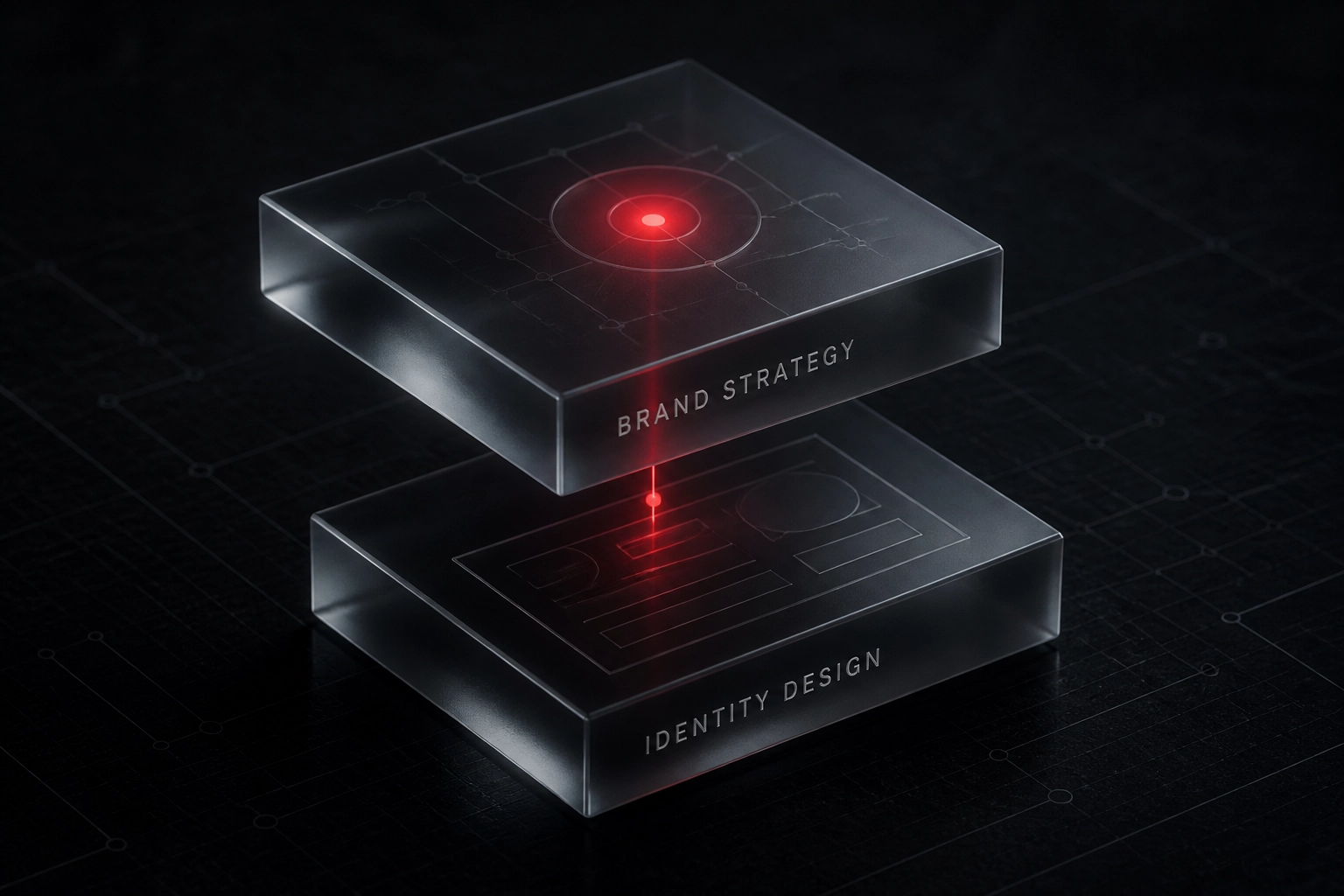
Brand strategy defines what your business stands for, who it serves, and why your audience should choose you. Brand identity design gives that strategy a visible form. These are distinct disciplines with a fixed sequence, and understanding that distinction is the first step to making either investment count.
Two Different Disciplines, Two Different Jobs
So what exactly separates the two?
Brand strategy is the foundation layer. It defines what a business stands for, who it exists to serve, and how it wins in its market. It answers the hard questions before any creative work begins: Why should a customer choose you over someone else? What do you actually stand for? Who, specifically, are you trying to reach?
Brand identity design is the expression layer. It takes those answers and gives them visible, recognisable form: the logo, colour palette, typography, tone of voice, and the visual system carrying your brand across every touchpoint.
A useful way to think about it: strategy is the floor plan, identity is the interior design. You would not choose furniture or paint colours before you knew where the walls were going. Design decisions made without a strategic foundation are decorative guesses, not considered choices.
Both disciplines are necessary, but they have a fixed sequence: strategy must come first, because identity draws its meaning entirely from the strategy beneath it. A logo for a business with no clear positioning is just a shape.
Conflating the two is one of the most common and costly mistakes in brand investment. For SMEs and NFP organisations operating with tight budgets and limited time, it is a particularly painful error: money spent on identity work before the strategy is settled often needs to be spent again. From strategy to spotlight, we make brands shine, but only when the strategic groundwork is in place first.
What Brand Strategy Actually Delivers
So what does the strategy phase actually produce? Concrete documents and frameworks, not graphics. Here is what a well-run brand strategy engagement delivers.
A positioning statement is an internal declaration of where the business sits in its market, who it serves, and why that audience should choose it over alternatives. It is not a tagline; it is the anchor that every subsequent decision, design or otherwise, is measured against. Research confirms that positioning acts as the mechanism through which brand investment translates into competitive advantage, making it foundational rather than optional.
Audience definitions and personas go beyond demographics. They describe motivations, concerns, and the triggers that move people from interest to action. For NFP organisations managing donors, beneficiaries, and government funders at the same time, this clarity is critical. Each audience needs a different message, and you cannot write those messages without first defining who you are writing for.
Competitive mapping is an honest audit of how your organisation compares to alternatives, identifying genuine points of difference rather than assumed ones. Many organisations discover their perceived advantages are not actually visible to their audience until this work is done.
A unique value proposition answers the question every potential client or supporter is silently asking: why you, specifically? It is one concise statement of the specific value you deliver that others do not.
A messaging hierarchy determines what you say first, second, and third across different channels and audiences, so every touchpoint reinforces the same core idea rather than pulling in different directions.
Core values and mission framing serve as operational filters, shaping hiring decisions, service design, and partnership choices, not wall decorations.
Together, these outputs form the brief that makes good brand identity design that delivers results possible.
What Brand Identity Design Actually Delivers
Once strategy hands you a clear positioning, audience definition, and messaging framework, identity design has something real to express. Here is what a professional brand identity design service actually produces.
A logo system covers more than a single mark. It includes primary and secondary versions, along with usage rules that keep the brand coherent across a website, printed brochure, vehicle signage, and social media profile image. Consistency across those contexts builds recognition; inconsistency quietly erodes it.
A colour palette is defined with precision: hex values for digital, CMYK for print, and Pantone references for physical production. Those choices carry emotional and cultural weight, and they should reinforce the strategic positioning rather than simply reflect what the founder likes.
Typography signals personality before a single word is read. A community legal centre and a property developer should feel distinctly different on the page, and the right typeface selections make that happen without extra effort.
Visual direction extends the system beyond the logo: photography style, illustration approach, iconography, and layout principles that make every asset feel like it belongs to the same brand. This is what separates a brand that looks considered from one that looks assembled.
Tone of voice guidelines are the verbal equivalent of the visual system. They define how the brand writes and speaks across every channel, from a grant application to an Instagram caption, so the personality stays consistent regardless of who is writing.
Together, these elements make strategy tangible and recognisable. A team that delivers results, optimises experience, builds brands, and creates engagement treats identity as a translation exercise, converting strategic thinking into something an audience can see, hear, and remember.
Without the strategy layer beneath it, however, identity work produces aesthetics rather than meaning. It may be genuinely beautiful and still fail to convert the right clients, because beauty without direction does not answer the question every buyer is silently asking: why you, and not someone else?
What Happens When You Reverse the Sequence

So what goes wrong when identity design comes first? Quite a lot, and the problems tend to compound.
Price becomes the default conversation. Without a clear positioning framework, a business struggles to articulate why it is different. When that happens, prospects default to comparing on price, because price is the only variable they can see. A polished logo does nothing to fix this; it simply puts a nicer face on an unclear value proposition.
The wrong people find you. Colour palettes and visual systems cannot filter for fit. Only a clearly defined position, built around a specific audience with specific needs, can consistently attract the clients, donors, or partners a business is actually built to serve. Design without that foundation casts a wide, undifferentiated net.
Rebranding cycles repeat. Brands that commission identity work before completing their strategy are significantly more likely to find themselves starting over within a few years, having invested in identity work twice or more without resolving the underlying confusion. The aesthetic changes; the strategic problem does not.
The design brief becomes guesswork. Without a positioning statement or audience definition, a designer has no strategic criteria to work against. Decisions default to personal taste, which may produce attractive work that does not serve the business’s actual objectives.
For NFP organisations, the stakes are particularly high. Communication built around internal values rather than audience needs weakens grant applications, donor appeals, and community engagement. Funders and supporters respond to clarity about outcomes, not organisational identity.
The cost is not only financial. Every year spent competing without a clear reason for clients or supporters to choose you is an opportunity that does not come back.
What a Strategy-First Process Actually Looks Like
So what does it actually look like when an agency gets the sequence right?
It starts with discovery and research, stakeholder interviews, audience surveys, and a structured competitive review. The goal at this stage is understanding: what the business genuinely does well, who it is truly built to serve, and how the market actually perceives it. No visual decisions happen here. A useful competitive review, as competitor analysis frameworks confirm, looks at what similar organisations are doing so you can identify where real differentiation exists, not assumed differentiation.
From that research, the agency synthesises a strategy document, sometimes called a brand platform. This captures the positioning statement, audience definitions, value proposition, and messaging hierarchy in one agreed reference. It is a working document, not a presentation deck.
Critically, the strategy is signed off before any design begins. Both client and agency agree on the direction in writing. That document then becomes the objective standard for every decision that follows. When a design choice is questioned later, the answer is found in the strategy, not in personal opinion.
The design phase opens with a creative brief drawn directly from the strategy. Every visual decision, colour, typography, imagery, tone of voice, has a traceable rationale. This is where user-centric design principles become practically useful: the strategy defines the audience, and the design serves that audience’s expectations and needs.
Feedback, too, changes. Instead of “I’m not sure I like this,” the question becomes “does this reflect our positioning?” That shift alone tends to reduce revision cycles and produce stronger outcomes.
This integrated, sequential approach is where serious brand strategy agencies are heading, because it makes results measurable against business objectives rather than aesthetic satisfaction.
Questions to Ask Before You Commission Any Brand Work
Knowing what a good process looks like is one thing. Knowing whether the agency in front of you actually follows it is another. Before you sign a proposal, these questions will tell you what you need to know.
- Are the strategy and design phases separated? The proposal should list distinct deliverables and milestones for each. If they are bundled together, ask the agency to specify exactly what strategic outputs you will receive before any design work begins.
- What documents will the strategy phase produce? A positioning statement, audience personas, competitive mapping, and a messaging hierarchy should all be named explicitly. Vague terms like “brand discovery” without defined outputs are a warning sign.
- How does the strategy inform the design brief? Ask to see an example of how a strategic output translates into a creative direction. Agencies with genuine capability can show this connection clearly; those without it will struggle to answer concretely.
- Who leads the strategy work? Strategy and design may be handled by the same team or by specialists working in sequence. Either can work well, but someone with strategy credentials should own that phase.
- What happens if the strategy shifts scope? A reputable agency will build in a review point before design begins, giving you the chance to validate the direction before committing to visual execution.
These questions protect your investment and quickly separate agencies with genuine brand strategy frameworks from those who have borrowed the language without the underlying process. If you reach the point of preparing a brief, that same thinking applies to scoping any digital project clearly from the outset.
Strategy Is Not a Premium Add-On, It Is the Brief

Those questions give you a practical filter. What they point toward is a simple principle: strategy is not an optional upgrade you add when the budget allows. It is the brief. It is the document that makes every subsequent design decision purposeful rather than decorative.
Brand strategy and brand identity design are sequential disciplines. Strategy defines where you sit in the market and why clients should choose you. Identity gives that position a visible form. Reverse the order and you may end up with attractive work that still fails to bring in the right clients, support grant applications, or justify a price premium.
The strategy phase has specific, named deliverables: a positioning statement, audience definitions, competitive mapping, a value proposition, and a messaging hierarchy. These are not vague discovery conversations. They are documents that become the brief for everything that follows.
For SMEs and NFP organisations working with constrained budgets, getting this sequence right is the difference between a single well-directed investment and a repeated cycle of rebranding that resolves nothing, because the underlying positioning was never resolved in the first place.
If you are weighing up whether you need strategy, identity, or both, the most useful starting point is not a logo brief. It is an honest conversation about where your organisation currently sits and what is actually getting in the way of growth or connection.
Reach out to Slant Digital today to talk through what a strategy-first process would look like for your organisation. We work with Melbourne businesses and NFPs, and we are happy to start with a straightforward conversation before anything else.
Conclusion
Brand strategy and identity design are not interchangeable. Strategy defines your position, your audience, and the reason clients choose you over every alternative. Identity gives that position a compelling visual form. Use them in the right sequence and your investment compounds. Reverse the order and even beautiful design will underdeliver.
For SMEs and NFPs working within real budget constraints, this distinction matters most. Getting the sequence right means one well-directed investment rather than repeated rebranding cycles that never resolve the underlying problem.
The most useful first step is not a logo brief. It is an honest conversation about where your organisation sits and what is genuinely holding back growth or connection.
Reach out to Slant Digital today to talk through a strategy-first process built around your organisation. We work with Melbourne businesses and NFPs, and we are happy to start with a straightforward conversation.